
If you're building a new home, your builder will almost certainly ask for an AS2870 site classification before the slab is designed. Whether you need a site classification in Brisbane or in Toowoomba, the report tells your engineer how the ground beneath your home is likely to behave. Spending a little time and money on soil testing now can prevent expensive foundation problems years later. At Soiltech, we've been carrying out residential site investigations across Queensland since 1986, and we've seen first hand how two neighbouring blocks can produce completely different results.
An AS2870 site classification is a geotechnical assessment completed under Australian Standard AS2870, Residential Slabs and Footings. The report identifies the type of soil beneath your proposed home and estimates how much that soil is likely to move as moisture levels change throughout the year.
Not all soil behaves the same. Clay expands after heavy rain and shrinks during long dry periods. Sandy soils are generally more stable, while filled sites or steep blocks can present their own challenges. The purpose of the report is to give your engineer reliable information before the slab is designed, rather than relying on assumptions.
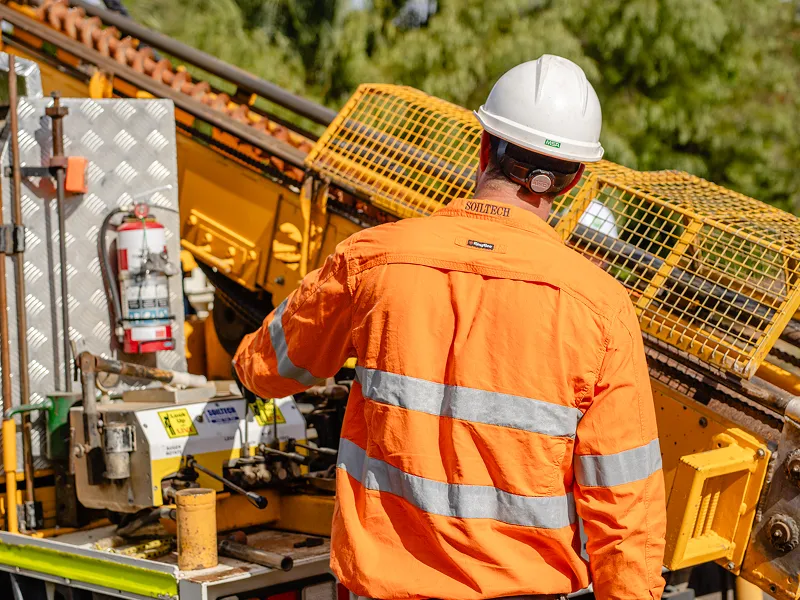
To prepare the report, boreholes are drilled across the proposed building area. Soil samples are collected, tested in a laboratory and assessed against Australian Standards before the site receives its classification.
Foundation problems usually start below ground, long before cracks appear in walls or doors stop closing properly.
We've inspected sites where the surface looked perfectly suitable for construction, only to find highly reactive clay less than a metre below ground. Without proper testing, a standard slab design could have been used, even though the soil required something very different.
An AS2870 site classification gives structural engineers the information they need to design foundations that match the actual conditions beneath your home. It also helps builders meet Australian Standards and local council requirements while reducing the risk of costly repairs later.
Receiving a highly reactive classification doesn't mean you can't build. It simply means the footing design needs to suit the conditions found on your block. Thousands of Queensland homes are successfully built on reactive soils every year because the engineering is based on accurate testing.
The AS2870 standard groups residential sites according to the amount of ground movement expected over time.
These sites have little or no expected ground movement. Stable sand and rock commonly fall into this category.
Slightly reactive clay soils. Some seasonal movement can occur, but it is generally limited.
Moderately reactive clay soils. Engineers allow for greater movement when designing slabs and footings.
Highly reactive clay soils. These are common across many parts of Queensland. Larger moisture changes can cause noticeable ground movement, so footing designs become more substantial.
Extremely reactive soils with very high movement potential. These sites require careful engineering.
Problem sites. This classification often includes uncontrolled fill, old creek lines, previous excavations, steep slopes or land that has been cut and filled during subdivision development. These sites usually require additional investigation before construction begins.
The classification is not a pass or fail result. It simply tells your engineer how to design a footing system that suits your site.
Many people picture a drill rig arriving, collecting a few samples and leaving. The investigation is far more detailed than that.
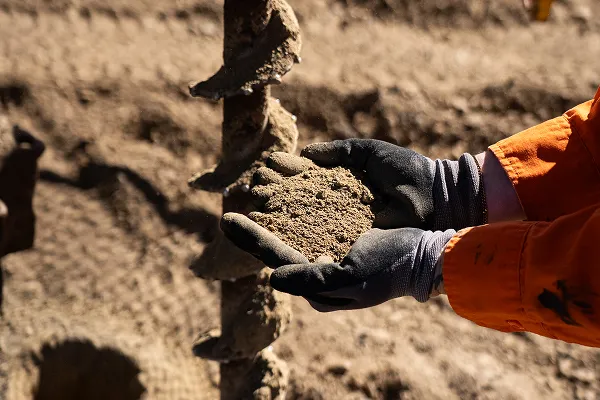
Boreholes are drilled at locations that represent the proposed building footprint. Samples are collected at different depths because soil conditions often change below the surface. In many cases, the soil found at 300 millimetres is completely different from what is found two metres down.
The samples are then tested in a NATA accredited laboratory to measure properties such as soil type, moisture content, plasticity and shrink swell behaviour. Those results are reviewed by experienced geotechnical professionals before the final AS2870 site classification is prepared.
The finished report gives your engineer the information needed to design footings that comply with Australian Standards.
You can learn more about the process here: What Is a Site Classification? Guide for Home Build
A site classification in Brisbane can vary more than many homeowners expect.
Western suburbs often contain highly reactive clay, while other areas sit on sandy soils that behave quite differently after periods of rain or extended dry weather. New housing estates may also include engineered fill, which needs to be assessed before construction starts.
It's not unusual for two blocks in the same street to receive different classifications. Soil doesn't follow property boundaries. That's why every site should be investigated individually instead of relying on nearby building reports.
Obtaining a site classification in Toowoomba is just as important because the region contains a wide mix of soil conditions.
Some residential areas regularly produce reactive clay classifications, while others encounter shallow rock or weathered basalt close to the surface. Local experience makes a difference because technicians who work across the Darling Downs understand the ground conditions commonly found throughout the region and know when further investigation may be needed.
Since 1986, Soiltech has completed thousands of residential investigations throughout Toowoomba and surrounding communities, giving builders and homeowners confidence that their reports reflect local conditions.
Arrange your soil investigation before your engineer starts designing the slab.
Waiting until building plans are complete can create unnecessary delays if the soil conditions require a different footing design. Testing early gives your builder, engineer and certifier the information they need before construction documents are finalised.
If you're purchasing vacant land, arranging a site investigation before construction begins can also help identify unexpected ground conditions that may affect your budget.
For more information, read our guide: Why Do I Need a Soil Test?
A report is only as good as the investigation behind it.
Collecting representative samples, recognising unusual ground conditions and understanding local geology all come from experience. A technician who regularly works across Brisbane, Toowoomba and regional Queensland will often recognise soil patterns that aren't obvious from a surface inspection alone.
That's one reason builders continue to work with the same testing companies across multiple projects. They know consistent field work and reliable laboratory testing lead to better engineering decisions.
At Soiltech, we've supported residential construction across Queensland for nearly four decades. Alongside residential investigations, we also provide geotechnical, construction materials and quarry testing services for projects of every size.
Learn more about our Residential Services.
You can also view a selection of projects we've completed: Soil Testing Projects Brisbane & QLD Case Studies
A properly completed AS2870 site classification gives your builder and engineer the information they need before construction begins. It reduces uncertainty, supports compliant footing design and helps avoid costly surprises once work is underway.
If you're planning a new home, extension or knockdown rebuild in Brisbane, Toowoomba, Warwick or surrounding Queensland regions, speak with the team at Soiltech. We'll carry out your site investigation, provide clear reporting and help your project get off to the right start.
An AS2870 site classification is a soil investigation completed under Australian Standard AS2870. It measures how reactive the soil is and provides engineers with the information needed to design suitable residential slabs and footings.
Most new residential homes require a site investigation before footing designs are completed. Builders, engineers and local authorities commonly request this report during the planning stage.
Class H indicates highly reactive clay soil. The soil can expand and shrink as moisture changes throughout the year. It does not prevent construction, but it does require a footing design that allows for that movement.
Yes. This happens more often than people expect. Soil conditions can change over short distances, which is why each block should be tested individually rather than relying on nearby reports.
The site visit is usually completed in a short appointment. Laboratory testing and reporting generally take several business days, depending on the project and testing requirements.
Yes. Soiltech carries out residential site investigations throughout Brisbane, Toowoomba, Warwick and many other locations across Queensland.
Your structural engineer uses the report to design a slab and footing system that matches your site's soil conditions and complies with AS2870 requirements. This design then forms part of your building approval documentation.

At Soiltech, we pride ourselves on providing professional and reliable soil testing services. Whether you're in the construction industry, civil engineering, residential development, or mining, our team of experts is here to assist you. Contact us today to schedule a consultation or inquire about our services.


